Star Finance Student Wins Hedge Fund Prize
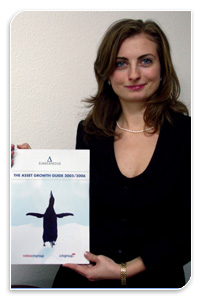
A student at the University of Reading's ICMA Centre has won a prestigious investment banking prize. Diana Calin, an MSc student studying International Securities, Investment and Banking at the ICMA Centre, University of Reading, has won the Eurekahedge Prize for the best paper on hedge funds after working on a major project which formed the bulk of her MSc.
Diana, who moved to the UK from her native Romania received a £10,000 scholarship from the ICMA Centre to study for their MSc in International Securities, Investment and Banking. She graduated in July 2006 with a distinction.
Her project - supervised by Jacques Pezier, Visiting Professor at the ICMA Centre - is an empirical study of Asian hedge funds employing a Long/Short Equity Strategy. Her paper is entitled ?Is there an optimal mix between alpha and beta benefits in hedge fund returns??, a title suggested by Eurekahedge.
This project is a significant commitment and is subject to a rigorous academic review. Students who focus their projects on hedge funds are able to access the Eurekahedge database of more than 7,000 hedge funds.
Diana said: ?I am delighted at being awarded the Eurekahedge Prize, an accolade that comes in recognition of my merits and of the hard work and dedication that went into producing my research project. This research explored the challenging problem of the evaluation of hedge fund returns, by differentiating between the benefits resulting from manager skill and the ones resulting from risk taking. I would like to thank both Eurekahedge and the ICMA Centre for having the initiative of bridging the gap between the academic and the financial markets.
?I now hold a Treasury Analyst position within Citibank Romania, after having worked for a short period of time for the Romanian Commercial Bank as an Assistant Manager Corporate."
Eurekahedge became involved with the ICMA Centre in 2005, working on a joint initiative to develop working papers on the hedge fund industry. The motivating factor for this partnership is the combined desire to encourage an appropriate risk management approach to alternative investments while bridging the gap between academic research and applied finance.
Research at the ICMA Centre focuses on quantitative finance, market microstructure, fund management, risk management and regulation; hence papers will focus on topics ranging from statistical analysis to portfolio construction of hedge of funds. To assist their research the academic staff and students at the ICMA Centre now have access the Eurekahedge database. The collaboration is set to continue with Eurekahedge offering more free use of further databases to ICMA Centre staff and students. This is particularly relevant to the ICMA Centre's new MSc in Investment Management which has attracted a large number of students for this academic session.
Diana's project will be mentioned in the Eurekahedge newsletter and she will also receive a copy of Eurekahedge's ?Asset Growth Guide?, a resource aimed at helping emerging fund managers as well as established fund managers to develop their businesses.
Three other students on Diana's course were also highly commended for their work: Antonios Vrailas, Hong Hung Quach and Yiannos Xenophontos.
| Published | 2 November 2006 |
|---|